Louis Cyr The Tragic Rise and Fall of the Worlds Strongest Man

Louis Cyr could make a crowd fall silent before he even touched a weight. At his peak, the Quebec-born strongman was said to have lifted a platform holding 18 men on his back, a load close to 4,000 lbs, and raised 600 lbs with a single finger. Those feats made him famous across Canada, the United States, and beyond.
They also helped build a body that could not last.
Cyr’s story is more than a catalogue of impossible lifts. It is the story of a boy from rural Quebec who became a global attraction, then paid dearly for the mass, strain, and lifestyle that helped make him unbeatable. By his early forties, he was ill. By his final years, he was restricted by serious physical decline. In 1912, the man widely remembered as the strongest on Earth died at just 49.

A powerful child grew up in rural Quebec
Louis Cyr was born Cyprien-Noé Cyr on 10 October 1863 in Saint-Cyprien-de-Napierville, Quebec. He grew up in a world where physical labour shaped daily life. Farms, lumber work, and transport demanded strength long before strength became entertainment.
Stories about Cyr’s youth often read like folklore. He was said to be unusually strong from childhood, with a body that developed early and rapidly. Like many legends from the travelling-show era, not every detail can be checked with modern precision. Yet the broad outline is clear. Cyr’s size and power stood out before he ever became a professional performer.
His family later moved to Massachusetts, where many French Canadians sought work in the 19th century. Cyr found jobs that suited a strong back, including mill and police work. He also began to test his strength in public. These early contests mattered. They moved him from local curiosity to paid attraction.
At a time when there were no viral clips, televised competitions, or standardised powerlifting meets, fame travelled by newspapers, posters, and word of mouth. A man who could lift what others could barely move became news. Cyr’s body became his passport.
Strength became his profession and his identity
Cyr entered a world where strongmen were entertainers as much as athletes. They performed in theatres, circuses, town halls, and exhibition spaces. Audiences came to see risk, scale, and spectacle. A lift had to be seen to be believed.
That suited Cyr. He was not only strong, he looked strong. His build was immense, with thick limbs, a broad waist, and the kind of physical presence that made even simple feats feel dramatic. By adulthood, he weighed well over 300 lbs, and later more than 400 lbs. In a period before modern sports nutrition, his size alone made him extraordinary.
He joined travelling shows and built a reputation through challenges. Some were formal contests against other strongmen. Others were staged demonstrations created to astonish spectators. Cyr lifted barrels, stones, dumbbells, platforms, and people. The feats were chosen for theatre as much as measurement.
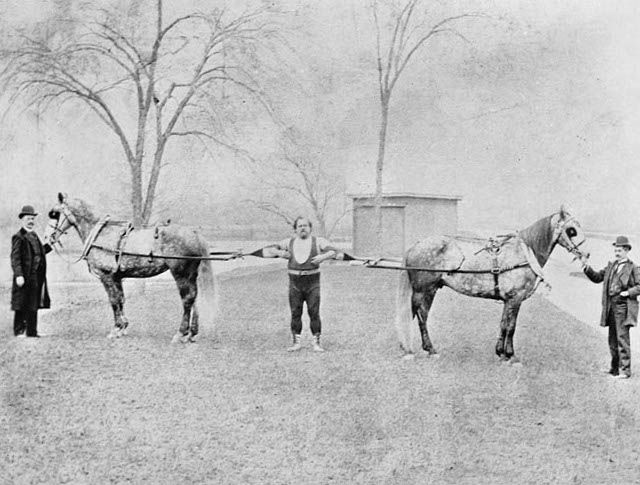
That does not make them meaningless. In the late 19th century, public strength culture valued practical-looking power. A man who could lift a horse, restrain a team, or carry a load of people seemed closer to the heroic labourer than the gym athlete. Cyr’s appeal came from that mix. He represented rural muscle, public showmanship, and national pride.
For French Canadians, he became more than a performer. He became a symbol of local strength in a world where Quebec’s identity was often contested and caricatured. His fame gave people something simple to cheer for. Here was a Canadian strongman who could stand against anyone.
The records made him almost mythical
Louis Cyr’s most famous feats sit on the border between sport, spectacle, and legend. Some were recorded by witnesses and newspapers. Others were repeated so often that they became part of his public myth. Even when treated with caution, the best-known lifts remain staggering.
One of the most cited feats involved Cyr lifting a platform on his back while 18 men stood on it. The total weight is often given as nearly 4,000 lbs. Another famous claim says he lifted 600 lbs with one finger. These numbers are so large that they can sound invented, yet they feature again and again in accounts of his career.
The difficulty with Cyr’s era is that strength records were not always measured under modern rules. Equipment varied. Judges varied. Some lifts used partial ranges of motion or special harnesses. Showmen also knew how to package a feat for maximum effect.
Still, dismissing Cyr because the era was different misses the point. He was not competing under today’s powerlifting standards. He was performing in the strength culture of his time, and by those standards he stood at the top.
Feat linked to Louis Cyr | Why it mattered |
Lifting a platform with 18 men on his back | It turned raw strength into a public spectacle that anyone could understand. |
Lifting 600 lbs with one finger | It showed extreme tendon, grip, and pulling strength in a dramatic form. |
Back lifts and heavy support lifts | These suited Cyr’s massive frame and made use of his whole body. |
Challenges against rival strongmen | They helped prove his reputation in front of paying audiences. |
Cyr’s greatness was not only in one lift. It was in the range of feats he could perform, and in the confidence he inspired. Audiences believed they were watching the strongest man alive because, in many cases, no one could produce a rival with a better claim.
The cost of mass was hidden in plain sight
The same body that made Cyr famous also placed him under constant strain. To maintain his size and power, he ate enormous quantities of food. Accounts of his diet vary, but they agree on the central point. Cyr consumed far more than an ordinary person, and his weight eventually climbed beyond 400 lbs.
In his world, mass was part of the job. Bigger meant more impressive. Bigger helped with certain lifts, especially support lifts where the body acted like a living column under a huge load. Bigger filled theatres. A huge strongman was easier to sell on a poster than a lean athlete with quiet technical skill.
Yet mass came with a price. Cyr performed before modern understanding of recovery, blood pressure, kidney strain, sleep health, and long-term cardiovascular risk. He lived in a culture that praised visible size and dramatic eating. For a travelling performer, rest was also hard to control. Long journeys, irregular schedules, public pressure, and repeated heavy demonstrations all wore on the body.
His strength was real, but it was not free.
Modern readers may be tempted to view Cyr as a cautionary tale about overeating alone. That is too simple. His decline likely came from a combination of factors, including extreme bodyweight, heavy strain, medical limits of the period, and the demands of performance life. Doctors of his time had far fewer tools than doctors have now. Conditions that can be monitored today often became disabling or fatal then.
This article is historical and informational. It does not offer medical advice or diagnose the full causes of Cyr’s illness from a distance.
Illness turned the strongman into a prisoner of his own body
By his early forties, Louis Cyr’s health had sharply declined. Historical accounts describe a diagnosis of Bright’s disease, a term then used for kidney inflammation and related kidney problems. He also suffered from heart trouble and partial paralysis.
For a man whose life had been built around public displays of control, the reversal was cruel. Cyr had spent years making impossible loads move. Now his own body resisted him.
The decline also changed the meaning of his fame. A strongman’s public image depends on permanence. Crowds want to believe that such strength is fixed, almost supernatural. Illness reveals the truth. Even the most powerful body is still vulnerable tissue, blood, nerves, and organs.
Cyr’s final years were deeply sad. Accounts describe him restricted to a specialised chair and placed on a milk-only diet. That image is hard to reconcile with the man who once stood beneath a platform loaded with men. It is also the part of his story that gives the title “world’s strongest man” its tragic weight.
He did not fade because someone stronger finally conquered him in a clean contest. He faded because the body that made him famous began to fail.
His death at 49 froze the legend in place
Louis Cyr died on 10 November 1912 in Montreal, aged 49. His death came young by any humane measure, especially for someone remembered for such physical dominance.
After his death, the stories grew. That often happens with figures who belong partly to sport and partly to folklore. The lifts became cleaner in memory. The numbers became symbols. The man became a statue, a mural, a record-book entry, and a point of cultural pride.
Yet the tragedy should not be brushed aside. Cyr’s legacy is not only that he lifted more than others. It is that he shows how easily admiration can hide cost.
People celebrated his size, but size burdened him. They cheered his feats, but each feat added to the myth that he had to keep living up to. They called him the strongest man on Earth, but no title could protect him from disease.
That tension makes his life more moving than a simple heroic tale. Cyr was not a cartoon giant. He was a working-class man from Quebec who turned unusual physical gifts into a career. He supported himself through strength in an age when few paths existed for someone like him to become internationally known. He earned his fame, and then he suffered in its shadow.
Why Louis Cyr still matters
Cyr remains fascinating because he sits at the beginning of modern strength culture. Before regulated powerlifting, televised strongman contests, and sports science, there were public halls, iron weights, wooden platforms, and men who built entire careers on what their bodies could bear.
His story also forces a mature view of strength. Strength can inspire discipline, courage, and awe. It can give someone dignity and opportunity. Yet when strength becomes inseparable from spectacle, the performer may have to keep becoming larger, louder, and more extreme.
That pattern has not disappeared. Modern sport is far safer in many ways, but the pressure to push beyond natural limits still exists. Cyr’s life reminds us that records are made by bodies, and bodies have limits.
The strongest man was still human
Louis Cyr’s rise was extraordinary. Born in Quebec in 1863, he became one of the most celebrated strength performers of the 19th century. His famous lifts, including the platform of 18 men and the one-finger 600 lb lift, still stretch belief. His size and appetite helped create a body built for feats that few people could even imagine.
His fall was just as important. Bright’s disease, heart trouble, partial paralysis, severe immobility, and death at 49 turned a legend into a warning. The strongest man in the world could lift thousands of pounds, but he could not lift himself out of the limits of the human body.
That is why Louis Cyr’s story lasts. It is not only about what strength can do. It is about what strength can cost.


Comments