The Cowra Breakout The Largest and Bloodiest Prison Escape of World War II

In the early hours of 5 August 1944, a quiet farming district in New South Wales became the scene of one of the most violent prison escapes of the Second World War. More than 1,100 Japanese prisoners of war rushed the wire at a detention camp near Cowra, armed with improvised weapons and driven by a fierce refusal to remain captive.
By sunrise, the breakout had left hundreds dead or wounded. Four Australian soldiers were killed. So were more than 200 Japanese prisoners. The event shocked wartime Australia and left Cowra with a difficult legacy, one shaped by death, fear, burial, reconciliation, and remembrance.
The Cowra Breakout The Largest and Bloodiest Prison Escape of World War II was not a spontaneous riot in the simple sense. It grew from a clash of military systems, cultural expectations, wartime pressure, and the grim reality of captivity.

A remote camp became the centre of a wartime crisis
Cowra sits in the Central West of New South Wales, far from the main battlefields of the Second World War. That distance was one reason the area became home to a large prisoner of war camp. It was inland, away from ports, and set in open country where escape seemed unlikely to succeed for long.
The camp held thousands of prisoners at different times, including Italians, Koreans, Formosans, and Japanese prisoners captured during the Pacific War. The Japanese prisoners were held in a separate compound known as Compound B. By August 1944, this compound was crowded and tense.
The Australian guards did not face an ordinary prison population. They watched over soldiers and civilians who had come from a military culture where surrender carried deep shame. For many Japanese prisoners, being captured meant social death. Some gave false names to avoid bringing dishonour on their families. Others feared they could never return home, even if the war ended.
The Australian authorities treated prisoners under the rules of war, including food, shelter, and medical care. Yet humane treatment did not remove the prisoners’ despair. To many in Compound B, captivity itself was unbearable.
The camp’s layout reflected wartime confidence in wire, lights, and armed guard towers. Each compound had huts, open areas, and fences. The prisoners were not expected to organise a mass assault under fire.
That assumption proved wrong.
Why the prisoners chose a mass escape
The Cowra breakout had been brewing before the night itself. Australian authorities had planned to move some Japanese non-commissioned officers and enlisted prisoners to another camp. Separating groups was a standard way to manage camp populations, but among the prisoners it raised alarm.
Many feared separation, loss of solidarity, and deeper humiliation. The order to transfer prisoners helped trigger a vote among the Japanese men. Accounts differ in detail, but the broad picture is clear: a large number chose action, even though they knew escape across inland New South Wales offered little real hope.
Their aim was not simply to run away and vanish. The breakout also carried the character of a mass death charge. Many prisoners expected to die at the wire or be killed soon after. Some used knives, baseball bats, tools, and other improvised weapons. Others prepared fires to create confusion.
This does not make the event easy to judge. The prisoners attacked guards who were carrying out their duty. The guards responded with military force against a mass rush on a secure camp. Both sides acted within the harsh pressures of war, fear, and duty.
That tension sits at the heart of Cowra’s memory. The breakout was not only a security failure or a battlefield-style clash. It was a human disaster with causes rooted far beyond the wire.
The night the breakout began
The breakout began around 2 am on 5 August 1944. A bugle sounded inside Compound B. Fires broke out in huts. Then hundreds of Japanese prisoners surged towards the fences.
The guards were startled but not defenceless. Searchlights, weapons positions, and armed sentries formed part of the camp’s security. As prisoners rushed forward, Australian soldiers opened fire.
Two soldiers, Privates Benjamin Hardy and Ralph Jones, played a central role in stopping part of the escape. They manned a Vickers machine gun as prisoners advanced on their position. Both were killed during the fighting, but their actions helped prevent more prisoners from breaking through at that point. They were later awarded the George Cross posthumously.
Other Australian soldiers were also killed during the breakout and pursuit. Lieutenant Harry Doncaster and Private Charles Shepherd lost their lives in the wider violence connected to the escape. Their deaths remind us that the danger spread beyond one fence line once prisoners entered the surrounding countryside.
The Japanese prisoners came in waves. Some climbed over or through the wire. Some died at the fence. Others broke out into the dark paddocks and roads beyond the camp.
The scene was chaotic. Fires lit parts of the compound. Shots rang out. Guards tried to hold positions while the camp’s emergency response took shape. Prisoners scattered into unfamiliar country, many wearing camp clothing and carrying little that could help them survive.
By the time the main rush ended, the scale of the event had become clear. More than 1,100 prisoners had escaped or attempted to escape. The number alone made Cowra stand apart from other wartime prison incidents.
More than 1,100 Japanese prisoners took part in the mass escape, making Cowra the largest prison breakout of the Second World War.
How the search unfolded after dawn
Once daylight came, Cowra faced a new emergency. Hundreds of escapees were loose in the district. Local residents had to stay alert. Australian soldiers, police, and members of the Volunteer Defence Corps searched roads, farms, gullies, and paddocks.
The fear was real. Rural families did not know whether prisoners might seek food, shelter, weapons, or transport. Yet the escapees had few supplies and little knowledge of the land. Most were exhausted, injured, or disoriented.
Some prisoners surrendered. Some were captured. Some took their own lives. Others were found dead from wounds suffered during the breakout. A small number resisted capture and were killed in later encounters.
Despite the scale of public alarm, no local civilians were killed. That fact matters, because it helps separate wartime rumour from what happened on the ground. The breakout was terrifying for the Cowra district, but it did not turn into a campaign against the civilian population.
Most escapees were back in custody within days. The countryside that had seemed like a possible route to freedom became a trap. Cowra was inland, distant from any realistic escape line, and surrounded by communities ready to report sightings.
The final toll was severe. Four Australian soldiers died. More than 200 Japanese prisoners were killed, with many more wounded. The exact figures can vary slightly by account, but the accepted scale does not change: the breakout was a catastrophe.
The dead were buried in Cowra
After the violence, Cowra had to deal with the dead. Japanese prisoners who died in the breakout were buried in the area. Over time, this burial ground became part of a larger story of remembrance.
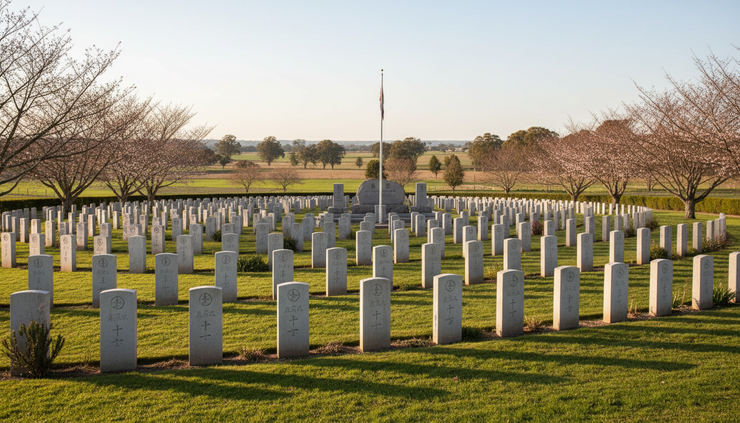
Cowra is now known not only for the breakout but also for its Japanese War Cemetery and Japanese Garden. These places did not erase what happened. They gave the town a way to face it.
The cemetery holds Japanese war dead, including those connected to the breakout. It became a rare and significant place in Australia’s war memory. The garden, created later, reflects friendship and reconciliation between Australia and Japan after the war.
That transformation is striking. A town once associated with fear and armed escape became a symbol of post-war respect. This was not quick or simple. The wounds of the Pacific War ran deep in Australia. Many families had lost people in brutal fighting or as prisoners of Japan. Sympathy was not automatic.
Yet Cowra’s later role shows how memory can mature. The town did not forget the Australian soldiers who died. It also accepted the duty to bury former enemies with dignity.
Both acts matter.
Why the Cowra breakout still matters
The Cowra breakout remains powerful because it resists a simple reading. It was an attack, a mass escape, a suicidal charge, a security crisis, and a cultural tragedy all at once.
For Australia, it exposed the reality that the Pacific War was not distant. Even inland towns could be touched by its violence. For Japan, the event reflected the terrible burden carried by soldiers taught that capture was shameful beyond repair. For Cowra, it became part of local identity, first as trauma, then as remembrance.
The breakout also forces a broader question about war captivity. Prison camps depend on rules, discipline, and control. Yet prisoners bring their own beliefs, fears, loyalties, and grief into the wire. When captors and captives understand honour, duty, and death in sharply different ways, the risk of disaster grows.
The Australian guards did not expect prisoners to choose almost certain death. Many prisoners did not see survival in captivity as mercy. That gap in understanding helped turn a guarded compound into a battlefield.
This does not excuse the violence. It helps explain why it happened.
What Cowra asks us to remember
The story of Cowra is not only about numbers, though the numbers are stark. More than 1,100 prisoners took part. Four Australians died. More than 200 Japanese prisoners were killed. Many more carried wounds, grief, or memory long after the guns fell silent.
The deeper lesson sits in the clash between military duty and human despair. The guards had a camp to secure. The prisoners had reached a point where captivity felt worse than death. Cowra became the place where those realities met in the dark.
Today, the town’s war cemetery and memorial spaces ask for a steadier kind of attention. They do not turn the breakout into a legend of glory. They present it as a tragedy that belongs to both nations’ history.
To remember Cowra well is to remember the Australian soldiers who stood their ground, the local community caught in fear, and the Japanese prisoners who died far from home. It is also to recognise how former enemies can choose respect after violence.
That is why the Cowra breakout still matters. It shows how war can follow people into captivity, and how remembrance can do more than preserve pain. It can give pain a place, a name, and a warning.


Comments